DARK HORSE: The Surprise Election and Political Murder of President James A. Garfield by Ackerman Kenneth D
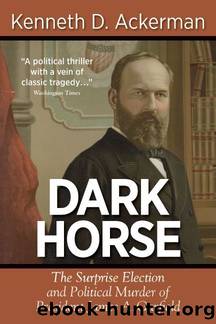
Author:Ackerman, Kenneth D. [Ackerman, Kenneth D.]
Language: eng
Format: epub
Publisher: Viral History Press LLC
Published: 2016-01-10T00:00:00+00:00
Tom Platt, standing near Conkling on the Senate floor as the news broke, could only hang his head in silence. He had hoped to avoid this collision by insisting on Garfieldâs promise to consult. Now Conkling would have to find out, if he hadnât already, about the embarrassing deal Platt had made in Albany the prior January to support William Robertsonâs appointment to the Custom House in exchange for the Half-Breedâs support for his Senate seat.84
But Conkling could care less about Tom Platt at that moment. He steadied himself. This was far from over. Presidents had the power to nominate, but the United States Senate had to give its advice and consent. He would not make this easy for Garfield and Blaine. For Robertson to become New Yorkâs Collector, his name must first come here, to the United States Senate, and Roscoe Conkling of New York would be ready to meet it. And certainly his Senate colleagues would back him; theyâd recognize the larger issue here. If a president like Garfield could impose this insult on Conkling, then he could do the same or worse to any other one of them. The sacred principle of Senatorial Courtesyâthat a Senator be allowed to veto any obnoxious appointment by a president of his own party in his own stateâmust be upheld.
Blaine himself said nothing that day to the newspapers as word of the appointments electrified the City, but Harriet Blaine had been around her husband long enough to recognize the real fingerprints in the affair. âDid you notice the nominations sent in yesterday?â she wrote the next day in a letter to her daughter. âThey mean business and strength.â85
------------------ -
Charles Guiteau waited until late March to visit the State Department to press his application for the Paris consulship with the Secretary of State, James G. Blaine. âI spoke to the General [Garfield] about it, and he said your endorsement would help it, as it was in your department,â Guiteau had written to Blaine on Riggs House stationery as early as March 11âjust after seeing the president in the White House. He enclosed a copy of his speech âGarfield Against Hancockââhis calling card, in case Blaine hadnât seen it yet.86 He followed up with another note a few days later: âThe pressure has been so enormous on you for office that I have studiously kept away from you, believing you would do the fair thing by me.â87 Then he sent another a few days later: âI think the President feels well disposed towards me about the Austrian mission, and with your help I can get it.â This time he added some flattery: âI am very glad, personally, that the President selected you for his premier. It might have been some one else. You are the man above all others for the place.â88
Guiteau knew that all the Stalwarts distrusted Blaineâespecially after Garfieldâs surprise nomination of Half-Breed William Robertson to the New York Custom House and his reshuffling of a half-dozen foreign postings. Guiteau himself
Download
This site does not store any files on its server. We only index and link to content provided by other sites. Please contact the content providers to delete copyright contents if any and email us, we'll remove relevant links or contents immediately.
| Anthropology | Archaeology |
| Philosophy | Politics & Government |
| Social Sciences | Sociology |
| Women's Studies |
The Secret History by Donna Tartt(19461)
The Social Justice Warrior Handbook by Lisa De Pasquale(12290)
Thirteen Reasons Why by Jay Asher(9110)
This Is How You Lose Her by Junot Diaz(7053)
Weapons of Math Destruction by Cathy O'Neil(6464)
Zero to One by Peter Thiel(5937)
Beartown by Fredrik Backman(5927)
The Myth of the Strong Leader by Archie Brown(5623)
The Fire Next Time by James Baldwin(5578)
How Democracies Die by Steven Levitsky & Daniel Ziblatt(5321)
Promise Me, Dad by Joe Biden(5228)
Stone's Rules by Roger Stone(5184)
A Higher Loyalty: Truth, Lies, and Leadership by James Comey(5080)
100 Deadly Skills by Clint Emerson(5023)
Rise and Kill First by Ronen Bergman(4890)
Secrecy World by Jake Bernstein(4864)
The David Icke Guide to the Global Conspiracy (and how to end it) by David Icke(4841)
The Doomsday Machine by Daniel Ellsberg(4616)
The Farm by Tom Rob Smith(4598)
